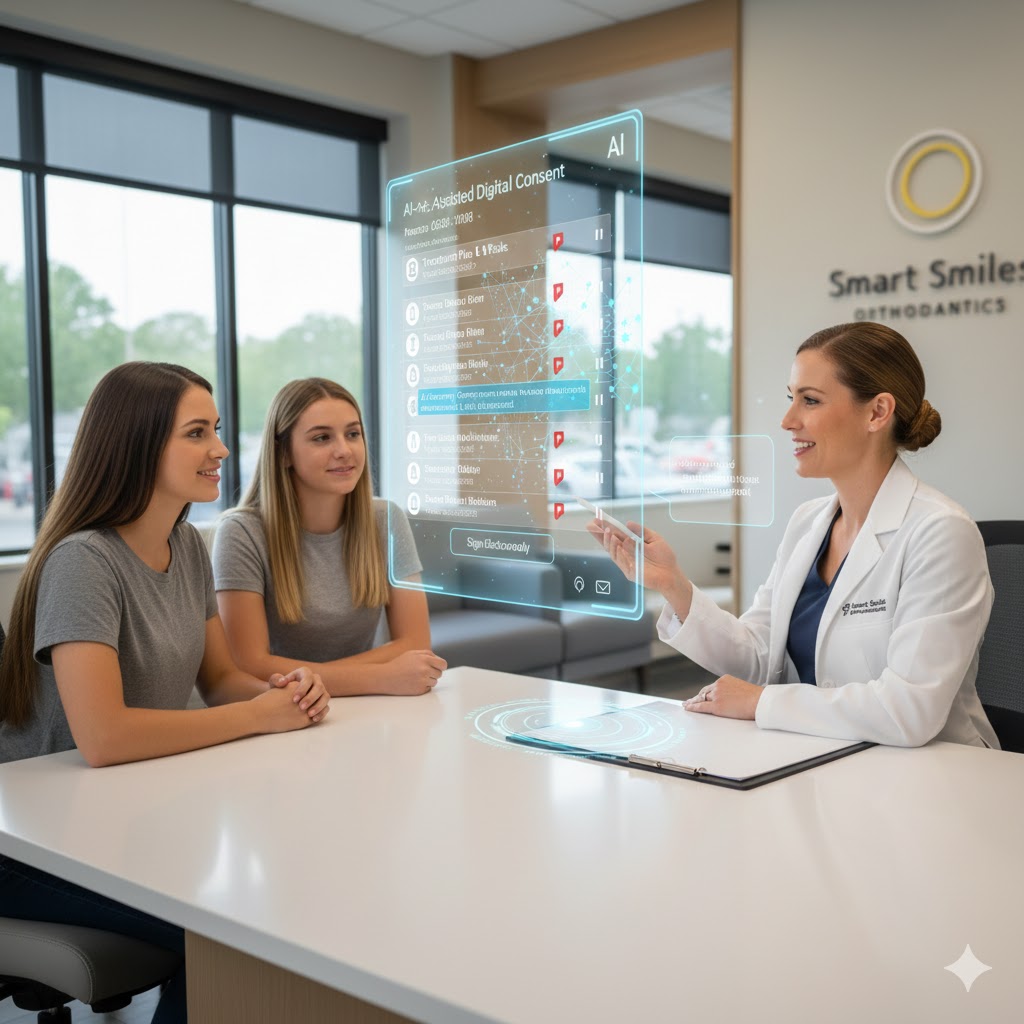
Automatically Pre-Filled, Context-Aware, and Seamlessly Integrated Into the Orthodontic Workflow.
Digital consent forms should make life easier for orthodontic teams and patients—not create additional work. Yet many practices still spend valuable time manually selecting forms, typing patient information, filling in treatment details, and double-checking that everything is accurate. This slows down the clinical workflow, frustrates patients during consults, and often results in missing information or incomplete forms that need to be revisited later.
Bracket OS eliminates these inefficiencies with AI-Assisted Digital Consents, a modern, context-aware system that automatically prepares the correct consent forms using the patient’s chart, treatment plan, and clinical history.
Instead of filling out forms manually, your team receives documents that are already complete — accurate, personalized, and ready for review and signature.
This is the future of orthodontic documentation: fast, intelligent, and effortless.
What Makes AI-Assisted Consents Different
Most PMS platforms offer “digital consents” in the simplest sense: a PDF, a signature box, and occasionally some merge fields. But the cognitive load is still on your staff to choose the right form, fill in details, update treatment specifics, match appliance types, and ensure accuracy.
Bracket OS uses AI to take over this entire process.
The AI engine analyzes:
- The patient’s chart
- Previous and upcoming appointments
- Planned treatment
- Clinical imaging and diagnostics
- Selected appliance types
- Patient-specific risk factors
- Treatment timeline
- Provider preferences
- Insurance considerations
- Age and responsible party details
Then it automatically selects the correct form and pre-fills it with contextually accurate information.
Your team simply reviews and confirms.
Automatic Selection of the Right Consent Form
One of the most common sources of errors in orthodontic documentation is selecting the wrong consent form—or missing one entirely. Some forms vary based on appliance type, procedure risk, patient age, or clinical context.
Bracket OS solves this by having the AI decide which consent forms are needed.
For example:
If the treatment plan includes:
- Clear aligners → aligner consent auto-selected
- Brackets → bracket/bonding consent auto-selected
- TADs → TAD-specific consent added
- Extractions recommended → extraction consent surfaced
- IPR planning → IPR consent appended
- Whitening, retainers, or custom appliances → corresponding add-ons included
The system recognizes the clinical scenario and chooses the correct documents without human intervention.
No more forgotten forms.
No more wrong versions.
No more manual guesswork.
Pre-Filling Based on the Entire Clinical Context
Bracket OS doesn’t just insert the patient’s name and birthdate—it fills the form with deep clinical and operational details that normally require manual entry.
Examples of fields the AI fills automatically:
- Patient demographic info
- Responsible party contact details
- Planned treatment type
- Appliance specifics (aligners, braces, ceramic, self-ligating, etc.)
- Estimated treatment length
- Phase of treatment (Phase I, Phase II, comprehensive, limited)
- Planned procedures such as IPR or extractions
- Financial arrangement reference
- Insurance coverage status or conditions
- Aligner staging considerations
- Special instructions noted by the doctor
- Allergies or relevant medical conditions
- Imaging referenced (pan, ceph, CBCT, photos)
- Provider information and location
- Emergency or risk disclosures tailored to the case
Because the AI understands context from the entire Bracket OS data layer, the consents are accurate and highly personalized.
Dynamic Text Generation Tailored to the Patient’s Case
Certain parts of a consent form vary depending on treatment details or the patient’s unique circumstances. Bracket OS uses AI to generate this text dynamically.
Examples of dynamic text areas:
1. Appliance-Specific Instructions
- Differences between ceramic vs. metal brackets
- Aligner wear guidelines tailored to the provider’s philosophy
- Specific risks associated with TAD placement
2. Treatment Duration & Expectations
Based on:
- Initial case assessment
- AI imaging analysis
- Typical case progression
3. Age-Dependent Language
Clearer communication for minors vs. adult patients.
4. Case-Specific Risk Notes
If imaging shows:
- Impacted canines
- Crossbite
- Bone loss
- Impactful movement requirements
The consent can include tailored explanations or additional sections.
This ensures:
- Accuracy
- Patient comprehension
- Legal protection
- High-quality documentation
Review, Approve, and Sign—All in One Fluid Motion
When the consent is ready, it appears in the patient’s digital chart for a final quick review.
Staff Can:
- Edit any field
- Add doctor-specific notes
- Adjust dynamic text
- Add additional consents if needed
- Request a provider review
Then the patient signs on:
- Mac
- iPad
- Office kiosk
- Or remote device (if enabled)
The entire process takes minutes compared to the lengthy manual process previously required.
AI-Driven Follow-Up and Compliance Tracking
Once a patient signs the consent, Bracket OS uses AI to monitor compliance and maintain proper documentation throughout the treatment journey.
The system logs:
- Exact version of each consent form
- Time and date of signatures
- Location and device used
- Provider and staff involvement
- Any changes made prior to signing
The AI also alerts your team when:
- A new consent is required (e.g., treatment update)
- Appliances change mid-treatment
- A procedure is added that requires additional documentation
- A consent is incomplete or unsigned
- A patient didn’t receive a required pre-treatment disclosure
This ensures nothing slips through the cracks.
Direct Integration With Charting, Imaging, and Financial Modules
Because Bracket OS is built on a unified data layer, every consent form interacts intelligently with the rest of the PMS.
Consents connect to:
Clinical Chart
- Treatment start flags
- Procedure authorizations
- Clinical notes connected to consent content
Imaging
- Links to relevant X-rays, photos, CBCT scans
- AI attaches imaging references automatically
Financial Module
- Payment plans tied to consent language
- Insurance benefit references synced
- Fee schedules applied accurately
Scheduling
- Alert if a procedure requiring consent is on the calendar without documentation
Orthodontists finally get a PMS where documentation isn’t just stored—it’s part of the workflow.
Designed for Mac and iPad—Sign Anywhere, Anytime
Bracket OS gives orthodontic practices flexibility:
On Mac
- Staff can prepare, review, and finalize forms
- Administrators can audit compliance
- Providers can amend text easily
On iPad
- Patients sign effortlessly during consults
- Doctors can annotate forms chairside
- Portable workflows for multi-location practices
Consents are always available, wherever the team is working.
The Result: Faster Workflow, Better Documentation, Happier Patients
AI-Assisted Digital Consents streamline one of the most tedious parts of the orthodontic process.
Benefits include:
For Staff
- No more manual form selection
- No more repetitive data entry
- Fewer errors
- Faster consults
For Doctors
- Accurate, contextually correct documentation
- Dynamic, personalized explanations
- Better legal protection
For Patients
- Clearer information
- Faster onboarding
- Confidence in the treatment journey
Conclusion: Consents That Complete Themselves
Documentation should support your clinical workflow—not slow it down.
With AI-Assisted Digital Consents, Bracket OS turns a traditionally manual, error-prone process into an intelligent, automated, streamlined experience.
The system:
- Understands the patient
- Understands the treatment
- Understands the clinical context
- Prepares the correct forms
- Fills in the details
- Keeps everything up to date
Bracket OS doesn’t just digitize consents.
It reinvents them with AI.